MuseAI Project Concludes: Laying the Groundwork for Future Media Verification Tools

After 18 months of dedicated research, development, and collaboration, the MuseAI project has officially come to an end— bringing to a close a focused effort to support the fight against digital misinformation and strengthen tools for media verification.
MuseAI was launched in response to the rapid rise of mis/disinformation across digital platforms, a phenomenon that poses serious risks to democratic discourse and public trust. The project set out to develop an AI-powered solution that could assist professional fact-checkers and journalists in identifying and verifying suspicious claims circulating online.
At the heart of MuseAI is a multilingual and multimodal system capable of analyzing diverse content formats—including text, images, and video—and detecting potentially misleading information. Its end-to-end AI pipeline not only flags questionable claims but also matches them with verified, semantically related statements from trusted databases, enabling faster and more scalable verification.
Designed with journalists and fact-checkers in mind, MuseAI offers a robust toolkit that enhances the speed, precision, and reach of media verification efforts. Whether parsing social media posts, news articles, or video transcripts, the platform empowers users to respond swiftly to emerging disinformation narratives.
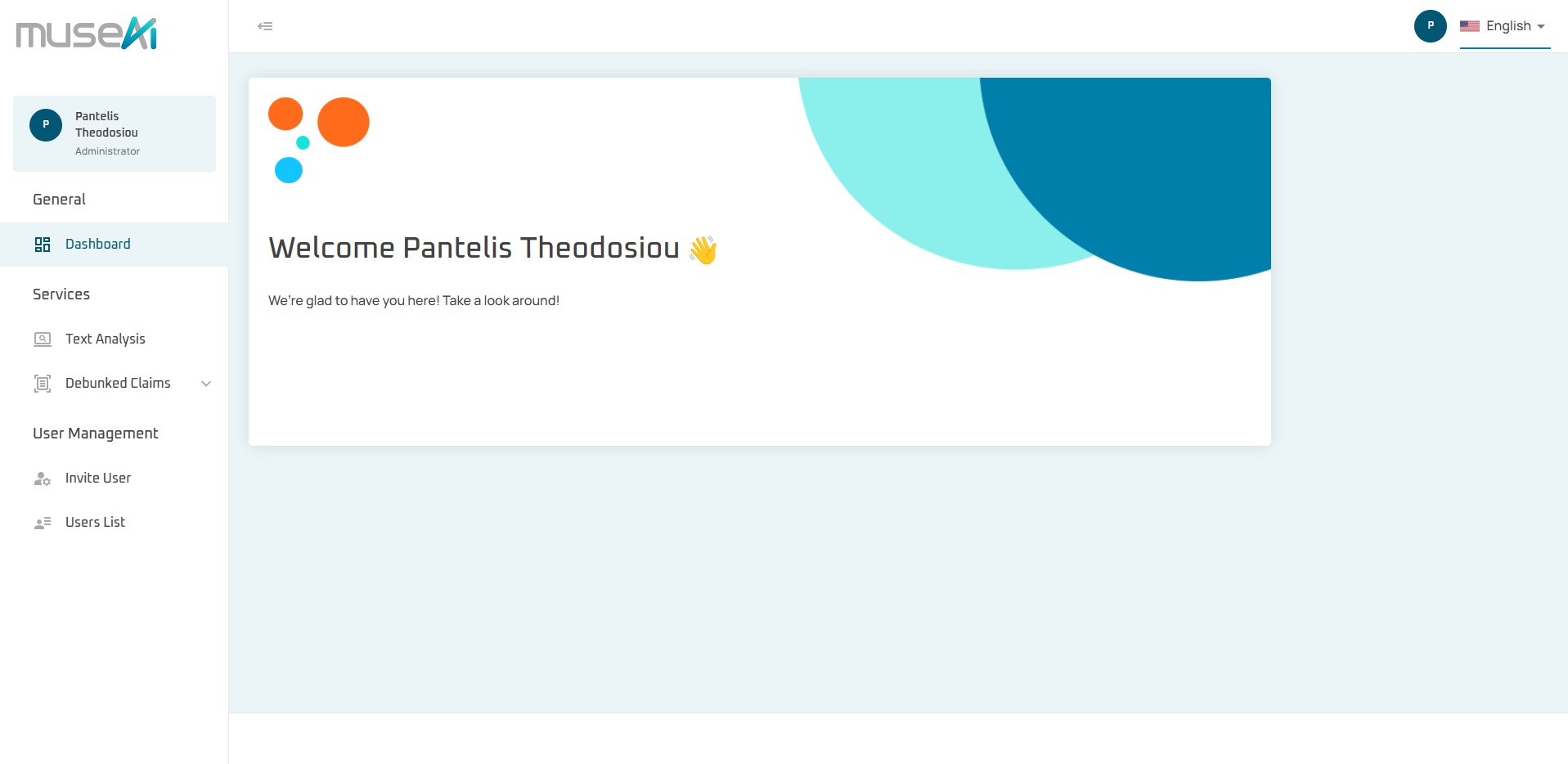
The MuseAI platform dashboard, providing quick access to claim submission, verification tools, and recent analysis results
The MuseAI consortium brought together expertise from three key partners:
- Athens Technology Center (ATC) – Greece
- Universidad Politécnica de Madrid (UPM) – Spain
- EFE Verifica – Spain
The project was funded by the European Media and Information Fund (EMIF), whose support was instrumental in enabling the development and deployment of MuseAI’s innovative technologies.
In technical terms, the MuseAI demonstrator features a secure and user-friendly frontend built with ReactJS and Vite, incorporating Material UI for consistent design and multilingual support to accommodate diverse users. It enables seamless interaction with the platform’s core functionalities, including claim submission and verification. The backend, developed in Java using Spring Boot and deployed in a Kubernetes environment, serves as the central hub connecting the frontend, external services, and the MongoDB database. It handles authentication via JWT, user management through RESTful APIs, and integrates essential services such as web scraping, claim detection, and claim matching. A dedicated FastAPI-based module supports real-time semantic matching of claims using pretrained models and continuously updated embeddings.
The claim detection module, implemented in Python and exposed via a Flask API, uses a multi-step LLM-powered pipeline to extract and rank factual, check-worthy claims from input text.
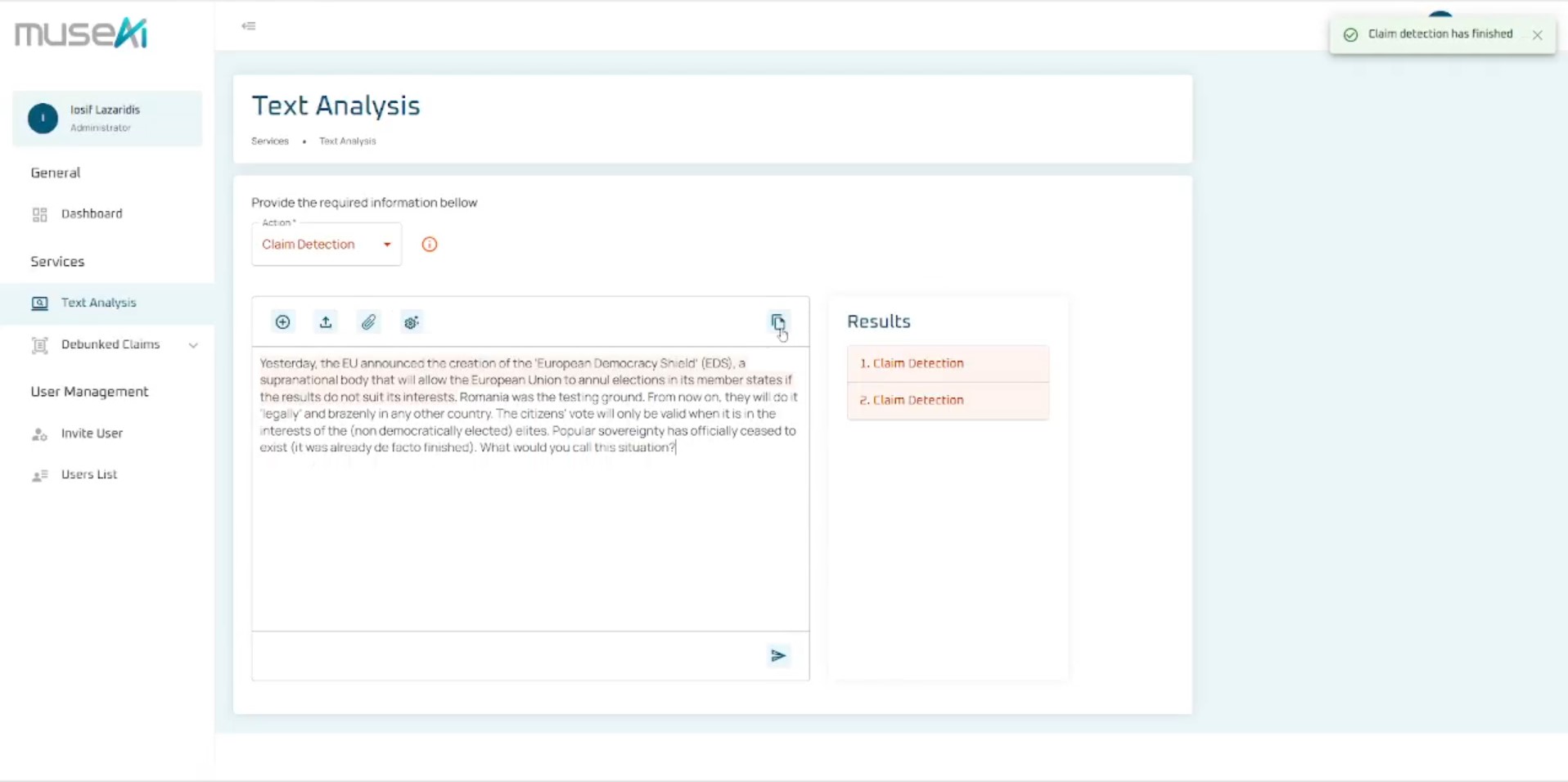
Claim detection workflow highlighting identified check-worthy statements for further verification
It leverages the Groq LLaMA 3-8B model for efficient and accurate processing. Meanwhile, the claim matching component compares submitted claims against a database of verified fact-checks using vector-based semantic similarity techniques. This service, also built with Java and Spring Boot, ensures scalable and multilingual retrieval of relevant matches.
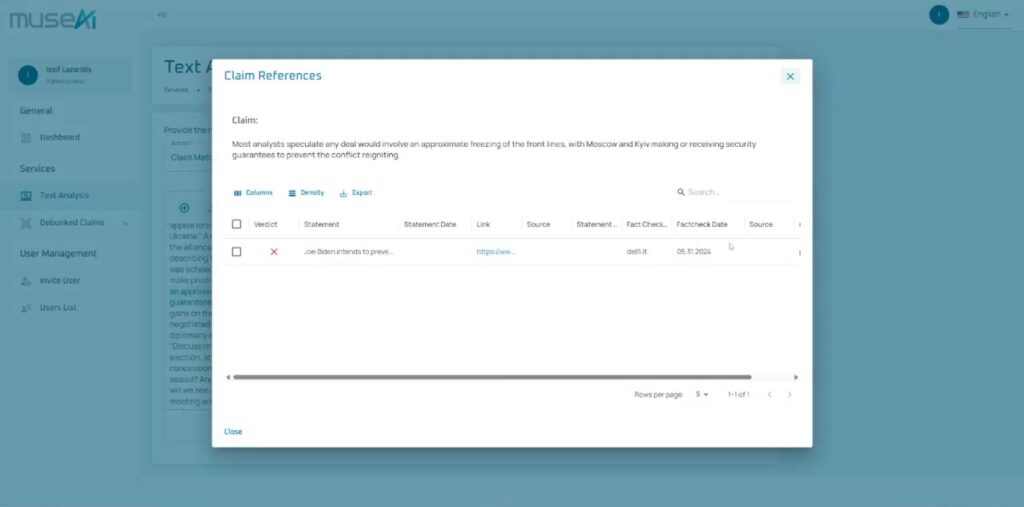
Claim matching interface displaying relevant verified fact-checks with verdict.
Together, these components form a modular, extensible system designed to support real-world media verification workflows and future enhancements.
As the project concludes, MuseAI has delivered its first release, laying the groundwork for future advancements in AI-driven fact-checking. While the current solution demonstrates strong potential in supporting media verification, there is ample opportunity to build upon its architecture, enhance its capabilities, and adapt it to evolving challenges in the digital information space. The tools, insights, and collaborative foundations established during the project offer a solid starting point for continued innovation in the field.
Stay connected via the MuseAI website and X platform for final updates, publications, and reflections from the team.